
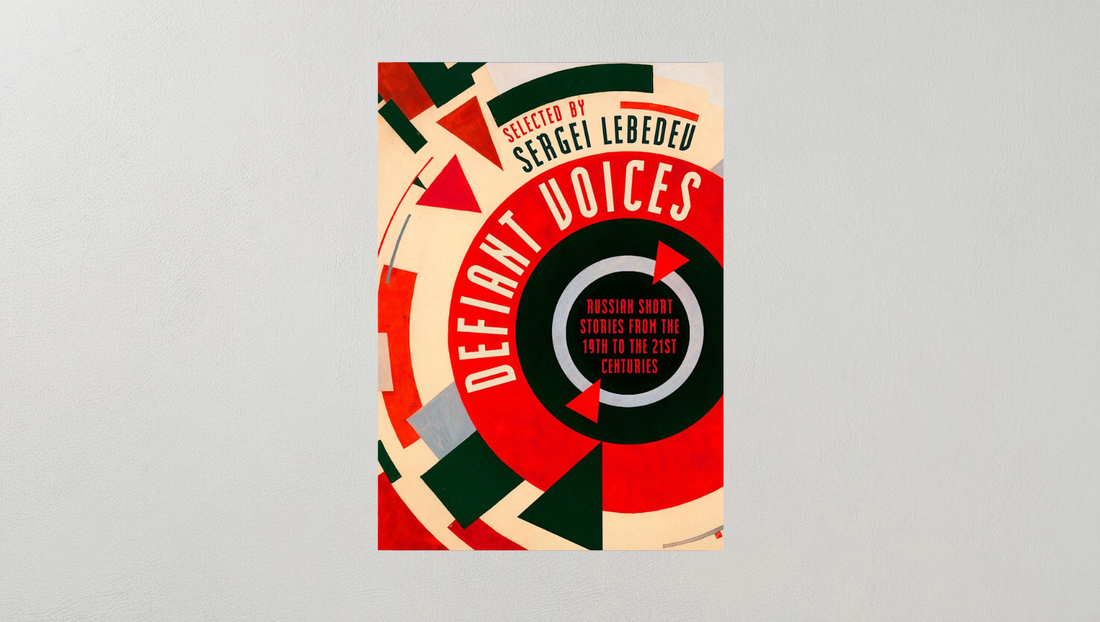
We are pleased to share this interview with Sergei Lebedev, one of the most perceptive contemporary Russian writers, and the curator of the new anthology Defiant Voices: Russian Short Stories from the 19th to the 21st Centuries (published by Head of Zeus) which was our April 2026 Book of the Month.
Defiant Voices brings together stories by 80 Russian-speaking authors spanning diverse geographies, epochs, artistic and political identities, but united by their defiance and resistance against empire, censorship and oppression.
Here are stories of defiance smuggled through samizdat, hidden amid satire, recorded as witness, or brazenly speaking truth to power. Stories written for a purpose, or merely for the sake of expression when expression itself was forbidden. Stories written in the depths of empire, in prison or in emigration.
While acknowledging the violence that the Russian language can carry, and the complex lives of some of the authors, Defiant Voices nonetheless speaks to the power of literature as resistance throughout Russian history; the power of “a lone man with a typewriter.”
Sergei Lebedev tells us about the practices of defiance and reflections of Russian history in the book, about re-examining the authors weaponised by the Russian state, about the stories that resonated with him the most, and much more.
---
What are your top five recommended books?
It would have to be Homer’s The Odyssey, Marcel Proust’s In Search of Lost Time, Varlam Shalamov’s Kolyma Tales, Philippe Sands’ East-West Street and Sofi Oksanen’s Purge.
What is a book that inspired you as a young person?
All of the Sherlock Holmes stories written by Sir Arthur Conan Doyle. One of the most important ideas to arise, for me, from reading those is that evil always leaves a trace; it cannot be untraceable.This is why we are able to fight it.
What is a book that takes you back to a specific place or time?
Alistair MacLean’s HMS Ulysses, which I read on the shore of the Barents Sea, exactly where the Allied convoys were fighting their way to Murmansk.
What are you reading at the moment?
I’m reading Umkämpfte Zone by Ines Geipel, a very thoughtful account of how one confronts huge crimes from the past within one‘s own family.
Which book are you looking forward to reading?
I’m looking forward to reading Jack Fairweather’s The Prosecutor: One Man's Battle to Bring Nazis to Justice. It’s the story of the West German prosecutor Fritz Bauer and his fight to punish the perpetrators of the Holocaust – a fight which ultimately reshaped the German public conscience.
What is your desert island book?
The Mysterious Island by Jules Verne.
What is a book that cheers you up?
Tolkien’s The Lord of the Rings, with its emphasis on the power of hope and resistance.
What is a book you wish you’d written?
Also The Lord of the Rings!
If you were having a fantasy dinner party, who would you invite?
I’d invite the early artists from the prehistoric era who are, to us, nameless and unknown. They wrote on clay and papyrus and were the first to take the initial steps into storytelling.
Why did you decide to compile Defiant Voices?
It all started with an invitation from my publishing house, Head of Zeus. I spent some time considering whether to accept it. It’s a very ambitious project and a huge responsibility. But then I decided that it would be interesting for me to re-read so many texts from the body of Russian-language literature and to contemplate how these texts can be read at a time when dictatorship has returned to Russia. A dictatorship which, amongst other things, selectively instrumentalises some of these authors, turning them into weapons of ‘Russian World’ propaganda. Do they possess, so to speak, this potential for defiance? Defiance is a tradition that is not merely a cultural artefact or a literary relic, but remains relevant today. In fact, this defiance is the subject of the research and the power of the anthology as a whole.
The practices of defiance in the book are varied – from satire to witness testimony, from fairy-tale subtlety to outright criticism. Could you share with us any particularly resonant moments in the anthology? What lessons about the practices or possibilities of defiance can we gain from these stories, or from their authors?
While compiling the anthology, I conducted research into declassified KGB archives in Ukraine and Lithuania. Whilst researching these materials, one particular observation struck me. In the secret police's operational reports, I saw how much effort was undertaken by state security to prevent people from writing particular books – an author’s memoirs about years of imprisonment in the GULAG, for example. Years of operative work, dozens of agents and the use of technical surveillance were employed just to destroy someone's intention to write. I could sense their apprehension about, and hostile respect for, a lone man with a typewriter.
So I would say that it is not a question of genre or the specific literary approach an author chooses. It is about the very intention to write outside the bounds of censorship and convention. Not all the authors in the anthology followed this; some accepted censorship, some tried to write between the lines. But the most precious, the most precise, are those lines untouched by the censor’s hand, because those authors refused to bow their heads.
The authors in this anthology belong to different generations, nationalities, political positions and literary styles. Can you tell us a bit about how they interact with each other, or the challenges of bringing them together? What can we learn about the ‘Russian literary canon’ through the lens of this book and its many facets?
First and foremost, I would say the book proves that there is no single ‘Russian literary canon’. I would even go so far as to say that there is no single Russian language within the scope of this book. There are Russian languages, divided by irreconcilable historical and political contradictions, languages that cannot always be brought together. They appear to form a single whole, but in reality there are frictions and contradictions between them, sometimes irreconcilable ones, such as those that might exist between denominations within a single religion.
Ivan Bunin would have been offended to learn that he found himself sharing these pages with certain authors who might be described as ‘Soviet’. And in this sense, the compiler of the anthology is committing a kind of coercion by arranging this juxtaposition.
In the introduction you mention that “Russian history, world history, live and breathe in the anthology’s construction”; many of the stories deal with real events of the past or present – some more openly than others. How do these stories reflect some events in Russian history? What do they tell us about how history is recorded through literature, or about the narratives and memories that emerge?
How and when does history become a story?
When someone is trapped within it, feeling powerless, or when someone becomes ready to fight it. It becomes a story when history, like the messenger in Stoppard's Rosencrantz and Guildenstern Are Dead, calls your name before dawn. When overwhelming powers force you into a situation. When there is nowhere to hide.
The Russian/Soviet history of the 20th century did not offer many opportunities to hide. Life in a totalitarian state is always a game of hide-and-seek with the state and its agents. However, this focus on victimhood and resistance should not obscure the fact that the oppressed can become the oppressor.
Svetlana Aleksievich is a Belarusian author – no one has contributed more to modern Russian-language literature than she has. She is renowned for exploring zones of crime and disaster, such as the Afghan War and the Chernobyl catastrophe, and examining the impact of 'Big History' on people's lives. In Aleksievich’s work the collision between common fate and individuality raises profound questions about the human conscience.
Her Boys in Zinc is a rare attempt to expose the Soviet colonial war, which has barely been reflected in culture to date (unlike the US war against Vietnam, for example). This war transforms internal repression into external aggression and serves as a vehicle for expanding authoritarian domination.
Did any of the stories make a particular impact on you? Or have any of the writers influenced your own writing?
My personal favourite is Varlam Shalamov’s Major Pugachiov’s Last Battle, a factual account of a revolt by GULAG prisoners. It is a very special piece of camp literature because it focuses not on suffering, but on the ability to resist. It is about pushing back against all the odds. It is about the dignity of armed resistance against oppressors. It is a written memorial to all those peasant rebels and national resistance movement fighters, mostly unknown or forgotten, who didn't just surrender but took up arms and fought the Soviet power. They were subsequently excluded from rehabilitation processes precisely because they resisted with arms.
For me personally, this is the strongest and, morally, the most important short story in the whole anthology.
Why did you choose to focus on the short story? Does it have a particular capacity as a literary form, or a significance in the historical or societal context?
I’ve often noticed that modern publishers lose their enthusiasm at the mere mention of the words ‘short story’. It is considered non-commercial, and not interesting to the wider readership anymore.
But given the reality of life for some authors in this anthology, the short story was chosen because it fits better into the life of the hunted and persecuted, who are on the run and cannot afford the time or resources to write a lengthy text that may take years.
What’s more, it seems to me that the short story is an important form in Russian-language literature for another reason. A repressive society, where institutional safeguards are weak or non-existent, turns life into a realm where chance reigns supreme: whether for good or for ill. And chance is precisely what lies at the heart of the short story.
Are there any stories (long or short) that you had to leave out, but you want to bring our attention to?
Ruchka, nozhka, ogurechik (A hand, a leg, a cucumber) by Yury Dombrowsky, who was a former GULAG inmate and a sensitive and profound novelist.
It’s a strange title, using the opening lines of a well-known children’s counting rhyme. And it’s a bit of gibberish, a nagging refrain that can stick in your head and keep playing on repeat.
This is a story in which Dombrovsky effectively described his own future death; he saw it as if in a dream or a delirium and wrote it down. In 1978, Dombrovsky was beaten up by unknown assailants – there is reason to believe this was done on the orders of the KGB. Thus, the story serves both as a tombstone for the murdered writer and as a strange testament to the prophetic powers of talent; powers which, unfortunately, do not always save the talented.
Could you tell us a bit more about expressions of defiance in Russian literature today? Are there any particular genres, themes, or forms which resonate with you, and which contemporary Russian authors should we be reading today?
It should be noted that defiance alone does not constitute moral clarity or integrity. Alexander Pushkin, an icon of the poet versus tsar struggle, was also the poetic voice of Russian colonial rule.
Aleksandr Solzhenitsyn, famous for fighting against the unjust Soviet system, later became a chauvinist and his work Russia in the Abyss can be seen as an ideological justification for the Russian invasion of Ukraine.
Therefore, we should learn from their strengths but also be very attentive to their failures. I would argue that modern Russian literature should be sensitive to this ambivalence, perhaps even making it a focal point of creative research.
As for reading recommendations, I would suggest several authors from the anthology list: Vladimir Sorokin, Dmitry Glukhovsky, Alisa Ganieva and Linor Goralik. In my opinion, these authors have the most precise moral compass.
I would also like to mention Anna Politkovskaya in particular. She was murdered on Putin's birthday in 2006. In light of the full-scale Russian invasion of Ukraine and the daily atrocities being committed, including attacks on civilian infrastructure and attempts to freeze Ukrainian cities during the winter, we should not forget her early understanding of the true nature and danger of the resurgence of the Russian dictatorship.
What are you working on next?
I don’t like to talk about books that haven’t been written. But I can tell you about another anthology I’d like to compile – or, rather, help to compile and produce. I’d tentatively call it Captive Languages and it would be an anthology of contemporary texts in the non-Russian languages of Russia. Texts devoted to the loss and rediscovery of one’s native language.
The fact is that modern Russia continues the imperial and Soviet practices of linguistic colonisation, and the Russian language is becoming its weapon: an instrument of displacement and replacement, of erasing national identities. Russian-speaking intellectuals prefer not to speak of this, as it undermines the image of Russian-speaking culture as uninvolved in the state’s repressive actions.
But I believe we must recognise that for many in Russia, Russian is a second, imposed language: not their mother tongue. That is why I would like to produce this anthology as a bilingual edition, translated into European languages, to clearly demonstrate the richness of languages and cultures obscured by the Russian language.


