
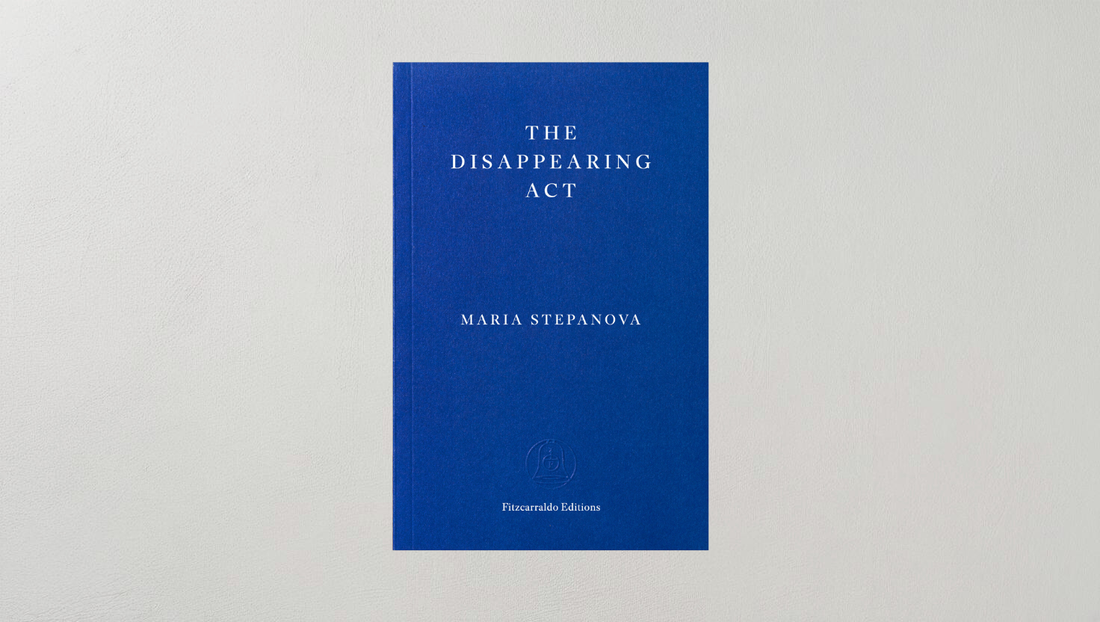
We are thrilled to share a special interview with Maria Stepanova, one of Russia’s leading writers, about her latest book The Disappearing Act, translated by Sasha Dugdale. The Disappearing Act was our Book of the Month in March 2026.
The Disappearing Act is a profound and quietly poignant reflection on identity and agency during times of war and displacement, told through a dreamlike narrative that slips from reality into the unknown.
In the book, a writer, M, lives in exile after her country invades its neighbour. She is severed from her former life and her future, and carries a burden of shame and guilt. Finding herself stranded in an unfamiliar town after an unfortunate series of events, M is presented with an opportunity – to be forgotten, to reinvent herself, or maybe even to vanish altogether.
We spoke with Maria about the story behind The Disappearing Act, its shifts between fiction and autofiction and its elusive heroine, as well as her thoughts on the current Russian literary landscape, reclaiming the Russian language through her writing, and much more.
---
Pushkin House: The Disappearing Act is your second book of prose, and your first book since the full scale invasion. How did the book come about, and why did you choose this genre? Could you tell us about the relationship between the auto-fictional elements (if we can describe them this way) and the fictional, or about your choice to weave magical elements throughout the book?
Maria Stepanova: Some things come unplanned, even unwanted, and that's how it happened with The Disappearing Act. At the moment when the full-scale invasion had started, I was deep into writing another book of prose, a big project, half novel, half fiction, that was keeping me busy for a few years. And 2022 was the year when I planned to move from researching to the actual writing process. It didn't happen, or, at least, it did not happen the way I planned. For quite a long while, I felt voiceless. I was deeply dissatisfied with everything that I tried to do during the first year of invasion, I could not even think forward. The only thing I could imagine writing was an essay (or maybe a sequence of essays) that would try to explain to myself the origins and consequences of Russia's aggression against Ukraine and my own part in it. I even had a title for it: "Inside a whale", a sort of a commentary or a counterpoint to Orwell's essay on Henry Miller and the writer's place in the dark times. It wasn't written – instead of that, and after more than a year, I suddenly started writing The Disappearing Act – rapidly, as if I was putting down a dream and the main thing was to put everything to paper and not to allow any detail to disappear. With In Memory of Memory, my first book of prose, the writing process was entirely different. I had free time to plan, to think, to revise myself, but in this case, the book was unfolding on its own, as if I was watching a film or, again, a dream. Weirdly, some points that I wanted to make in the whale essay found their way into the book – as if they were waiting for the right form.
So I did not choose the genre consciously, and it took me quite a while to define the genre after the book was written. In a way, it is closer to the old-fashioned genre of fable or a parable than to a novel. And, of course, it plays with reader's expectations – as well as with the overlapping conventions of fiction and auto-fiction. Up to a certain point, one may easily convince herself that the book is a straightforward account of my own story, my own experiences, and that the writer M is a one-to-one version of my own existence. It gave me significant pleasure to make the protagonist take impossible decisions, move in unexpected ways, stray further and further away from myself. But of course we have some things in common - and I enjoyed seeing her transform into something new.
PH: You mentioned in a 2023 interview that nowadays any work produced by someone from Russia is read primarily in relation to the war or to understanding Russia today. Even though so much in the book remains nameless (not least the protagonist and her home country), the context is unmistakable. How do you hope it will be received by the wider world in translation, or what understandings do you hope that your international readers will gain? (We note that Фокус has been consistently listed among the top books in Russian bookshops-in-exile).
MS: Frankly, not only do I have no expectations, I cannot even say that I have a coherent message that I want to share with the reading audience. I'm not sure that it works like that when it comes to writing. Politically, personally, my position is simple and straightforward: I stand with Ukraine. And if I were writing a newspaper article, which I do from time to time, that would be clear enough for a message.
But with prose, even with an essay, things work in a different way. You are writing in order to understand something, it is always an attempt to make things more clear for yourself alone – and at the end, if you are lucky, they clarify into an image or a formula. I try and fail and try again to reach the point where I can finally grasp some truth that was unknown to me at the beginning. And, as always, all I can hope for is attention and understanding.
I think I need to make a footnote here to clarify a certain point. As you know, as the narrative unfolds, the novelist M's former country is not named until the very end of the book – as well as the country she's living in now or the country she's heading to. I use initials instead of toponyms. Quite a few times I had to explain to non-Russian readers that this choice was not provoked by a wish to escape the Russian state censorship. My reasons were purely aesthetic; this book is a work of fiction with its own inner rules and circus tricks. For my purposes, it was important to give the story a quality of a fable – in our days a displaced writer, who is deeply conflicted when it comes to her heritage, might be coming from various parts of the globe. The Disappearing Act is not a confession, nor a treatise on collective guilt or the nature of violence in contemporary Russia. It is more of a mental experiment, a guessing game, even a dream of sorts. That is to say that aligning me with my heroine or taking her views as a direct expression of my own might be a bit simplistic – thank you for giving me a chance to reflect on this.
PH: Can you tell us a bit about the heroine of the book – how you constructed her character, or which aspects of her character were the most interesting or challenging to explore? We follow her in a process of transformation and reinvention. Transformation is one of the many forms of disappearance in the novel – among escape, abandonment, oblivion, and invisibility. How does she relate to these different forms, and is disappearance really an option for her?
MS: I suppose that the protagonist does not actually have much of her character left at the point when the book starts. What she has is a memory of what she used to be, some scraps and bits and pieces of her former identity that come up, almost unrecognisable, in the most unnecessary times. She is a sort of a non-being, a non-entity, a writer that does not write, but has, shamefully, to earn her daily bread as a writer. She does not even strive for transformation, it is hardly a possibility that she can imagine. Later, when the opportunity presents itself, she chooses disappearance – as a form of invisibility that she welcomes so much. But is it the only option left? What other versions of herself she can have in store? And is disappearance (with its various comforts) even possible – for my heroine or for anyone else?
PH: The role of language is central to The Disappearing Act. For your heroine, who is a writer, spatial displacement from her homeland only solves half the problem, as linguistic displacement is almost impossible. Whether as a carrier of violence, a shield to hide behind, or a knowing joke at a badly-named hotel, languages have many roles in the book. Can you tell us more about this?
MS: Of course, it is a crucial question – and also a question that cannot be resolved in the space of my book, or maybe any book. Personally, I don't believe in language-blaming, even in the situations when it is too tempting to see a certain language as an evil force or one of evil’s trinkets. My vision is different. I deeply believe in the innocence of any given language – a language doesn't have a chance to object, to resist violence; it is used and abused by anyone who wishes; it is no more than a vase or a candlestick that, in unhappy circumstances, might be used as a tool for murder. It is too easy to switch the focus from the people, real people that are responsible for violence to the language they were using or the boots they were wearing. In my understanding, it’s the humans who should be responsible for the acts of evil – humans and their personal choices.
But there is also an emotional side. It is really hard to process the feeling of anger and disgust towards your own origins, towards your own language, the one you think and write in, when you see how it changes in someone else's hands. For my heroine, it feels natural to stay silent, or to express herself in another language – crude and unwelcoming as it might seem when you don't really know it. It gives her the anonymity she is craving. My own personal choice is to continue writing – simply because that is the only thing I can do to counterbalance the distortion. Someone has to use Russian as a language of love, and even more so if it is being actively transformed into a language of hate; someone has to claim this language back. I guess, for a writer it is a mode of resistance.
PH: Can we observe any links or tensions between In Memory of Memory and The Disappearing Act? Is there a continuation of, or rupture between, any particular themes? Examples that occurred to us are themes of perception of the past, roots, or personal agency.
MS: I certainly think so, even if I would hesitate to explain what the actual connection is. I have a feeling that for all my life, I was dealing with the same set of questions, trying to answer them in different ways, from different points of view. In Memory of Memory was an attempt to finally solve one of those questions – an obsession with the past that defined my thinking for a quite long time.
Needless to say that I did not solve it – can one really get rid of an obsession by writing a book? – but I did have a fleeting sense of closure, until I had to reopen the case and start answering the same questions again, with a sudden urgency. Writing In Memory of Memory (and it was 10 years ago, after the annexation of Crimea, and on the backdrop of everything that was happening in Russia) I still had a feeling that the times of grand historical catastrophes are in the past, and that my personal and moral duty is to gather the remnants, put the relics together, and try to make sense of the gaps and missing pieces. Little did I know of the catastrophe that was yet to follow.
In The Disappearing Act, my heroine, the novelist M, is cut away from her past by a sense of shame that she cannot overcome. Neither does she have a vision of a future – that is something we have in common. It makes me think of the pandemic times: one feels locked and has to find a way out by waiting for the signs, or palpitating the walls, or sawing oneself in halves.
PH: You published Фокус with Series 24, a publishing cooperative spread across publishing houses and cultural centres in Europe and beyond. As well as your involvement with the rapidly developing new tamizdat world, you also are involved in centres of Russian culture abroad (not least Pushkin House!) Could you share some thoughts on this new cultural or literary landscape?
MS: I think it is essential to make this newly emerging landscape even more broad and diverse – on the background of the processes that are unfolding in the Russian literary world, we need more uncensored spaces for literature and for a conversation devoted to literature. Cultural spaces, publishing houses, different forums of cultural journalism (there is a visible gap when it comes to in-depth discussion of cultural and societal processes, and that's a serious problem and also a challenge) will be developing further – or so I hope.
But I also find it important to resist the temptation of presenting the literature written in Russian as these two separate flows: literature in exile and literature in Russia, as they used to do a century ago. To start with, there is something deeply humiliating in the way contemporary life borrows its models from the 20th century – and I would prefer to refrain from copying the old examples, if out of sheer aversion for tautology. A fair number of my colleagues that write in Russian today would be seriously against any association of their writing with the Russian state. It seems fair to regard their works as a Russian-language branch of some other literature: English, German and so on, or maybe to claim that they belong to the bigger entity – the multilingual, borderless, stateless literature of exile that seems to be gaining more and more attention worldwide. On the other hand, I can't deny that everything I write is deeply intertwined with the words and thinking of my friends and colleagues staying in Russia and trying to resist the regime from the inside. I don't want to be separated from them on the theoretical level as well as on the level of our inner dialogue – and for this conversation, our geographical situation doesn't seem a defining factor.
PH: Are there any particular writers, artists, or other cultural figures who you think we should be paying attention to?
MS: The list of names to follow is far too long – and even reducing it to the authors that are translated into English doesn't help much. Let's start with poetry: it works now with cutting-edge precision and reflects the seismic changes in society and human psyche. Elena Fanailova, Polina Barskova, Leonid Schwab, Anna Glazova form my everyday survival kit – reading them is a necessity. And there is the younger generation of poets and prose writers: Daria Serenko, Oksana Vasyakina. The composers: Leonid Desyatnikov, Sergej Newski, Boris Filanovsky. For many years I try to follow everything that is staged by Dmitri Tcherniakov. I try to be brief here – but there are so many names that should be attracting attention.


1 Comment
Excellent interview. Really great questions. Her idea that we should not separate contemporary Russian literature into two distinct “flows “, depending on on whether it was written in Russia or in emigration, raises a very important question. point.