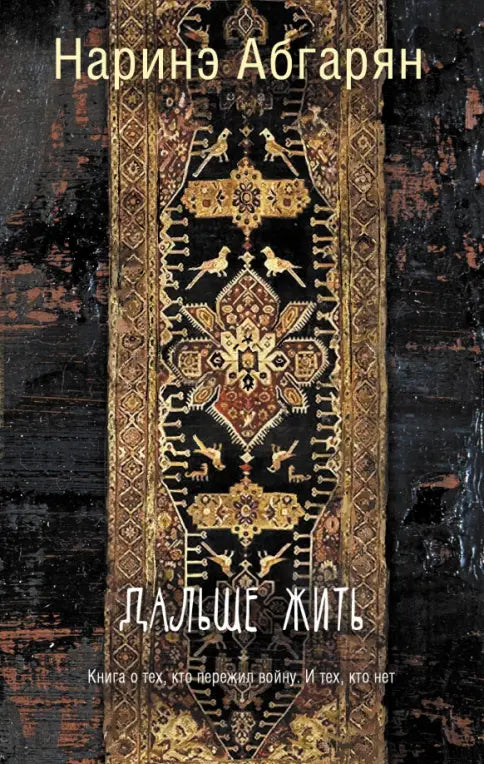
Literature about the Caucasus has a special place in my heart, whether written by authors born there or by travellers to that ancient, restless land that captivates by its spectacular beauty, enduring history and the unbridled pride of its people. Narine Abgaryan's narrative is deeply rooted in the myths of her Armenian ancestors, and it seems that nothing can interrupt the never-ending flow of life. The captivating storytelling in my favourite Three Apples Fell from the Sky (С неба упали три яблока) is about the beauty of her land, the pride of her people and, above all, it is about human existence in which lives and memories are intertwined in an unbreakable continuum, be it the animate or inanimate world. This theme unfolds as a leitmotif in her other collected works including To Go on Living (Дальше жить), which chronicles the lives of an Armenian community in a war-torn territory. In the story Прогулка (Stroll), an adolescent girl who has lost her mother and aunts during the war, retreats into a world of her own, where she sees the sorrowful shadows of her loved ones in particles of dust or mist, or hears their voices in the currents of the river. In Loneliness (Одиночество) a dead mother is entombed beneath a pile of clutter after her ancestral home is destroyed by an enemy shell, and her grief-stricken son muses on the significance of the seemingly useless junk that surrounds his mother in her death. And yet he accepts that she could not part with any of it because every object carries memories of long-departed relatives, and every item preserves the imprint of their touches and traces of their souls.
The poetic flow of Abgaryan’s prose is both beguiling and unsettling. Her narration brings forth not only what is beautiful and romantic but also what is deadly and ugly. Death lurks just beyond the fields, and to outwit it, the villagers must harvest the crops either at dusk or at dawn. For the author, it is imperative to summon up the courage to stare death in the face in order to assert life. One must go on living.
To Go on Living is about war. Yet the enemy is never visible, though his presence is felt everywhere. The only enemy revealed to a village girl, whose pregnant mother has just been killed in an attack on a civilian bus, turns out to be a hapless Azeri youth who has been caught in the fields by the girl’s father and is being held captive to be exchanged for an Armenian prisoner. With all the suffering around, revenge might seem to be the right emotion. Yet the helpless youth stirs nothing but pity and is offered help by the girl and her paternal grandmother. In the end, the old woman sets him free. Is this a metaphor for hope and reconciliation? What message will the youth carry back to his own people?
Abgaryan writes in Russian, which is not uncommon for writers who emerge from a legacy shaped by the dominant cultures of empires, whether in modern or ancient times. I feel privileged to be able to appreciate her beautiful writing in the original. However, because of the war in Ukraine, the Russian language is going through a difficult period at the moment. I find myself feeling guilty about my inability to converse in Ukrainian, the language of my father, with my Ukrainian friends. In my ethnically mixed family in the Caucasus, we naturally spoke Russian. For Abgaryan, I suspect, writing in Russian is also an entirely natural act. We must accept that, at this moment in history, the Russian language is being held hostage by a fascist dictatorship which, through brute force, is trying to mould it in its own image. But dictatorships fall, and, just like prisoners of conscience, languages are liberated to go on living in their natural cultures and traditions.