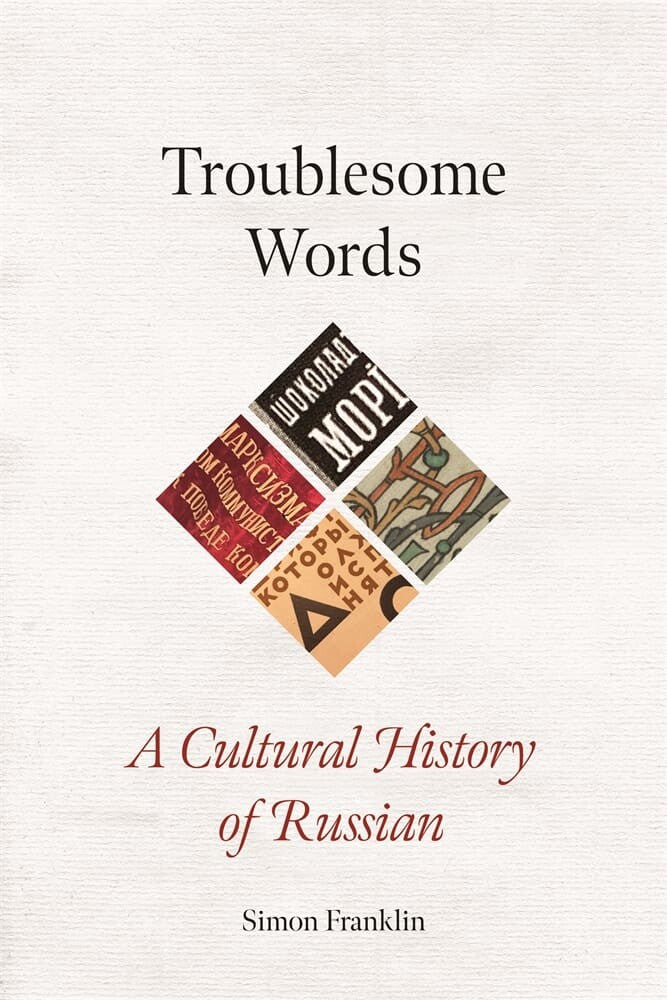
Troublesome Words: A Cultural History of Russian by Simon Franklin
(5.0)
(1) 1 total reviews
"Troublesome Words is an engaging, erudite and witty exploration of the origins of the Russian language. Simon Franklin sets out in an accessible way how Russian speakers have made sense of the world throughout Russia’s turbulent and often violent history. He maps out the religious, political, societal and cultural forces that have shaped today’s Russian language, the uses to which it is put by Russia’s political leaders, and how “non-normative” use of language is used to challenge authority. Highly recommended" – Laurie Bristow, President of Hughes Hall, University of Cambridge, and former UK ambassador to Russia
Language can be a battleground of ideas, and nowhere is this more vivid than in the Russian context. Across 350 years, Russian has been shaped by competing visions of what it should be, from early grammarians defining a literary standard to digital-era debates about slang, obscenity and online identity. Simon Franklin traces how tradition and disruption have continually reshaped the language, including sections on the discovery by the educated elite of the language of ‘the people’, the linguistic experiments of writers and revolutionaries, politics and the rhetoric of empire. Clear, concise and engaging, Troublesome Words is both a history and a cultural portrait, examining the global diversity of Russian today and revealing how language reflects power, imagination and the changing world.
Hardback
Couldn't load pickup availability
Share
Congratulations on the publication of Simon Franklin's new book Troublesome Words. A Cultural History of Russian! I've read it and liked it very much, found it timely, important and much needed as to foreign students of Russian, and also to many Russians like myself. The book is very useful in the best sense of the word (своевременная, нужная и полезная книга), necessary and practical for anybody who would like to put together, understand more deeply the (step-by-step) historic development of the Russian language from its source to our days. Many educated Russians of my generation know or supposed to know/remember most of this material from our Soviet school/university curricula. But the bits and pieces of this general knowledge have often been scattered in the memory in a rather disorganized way, especially of those not professionally connected with the Russian language studies. Many lack that much more detailed historic picture closely connecting the major events.
As for the foreign students of Russian the book provides a clear solid historic information, often sounding new since most textbooks don't contain it in such detail and logical sequence. In fact I haven't heard of another book in Russian or English that would cover this material with equal precision and purpose.
The text is accessible, lively, witty, with many vivid examples and illustrations, stylish, appealing to different levels, shows the depth and width of the author's knowledge of the subject.
I was touched by Simon's dedication to his late Russian wife Natasha. I agree, it is possible that with Natasha's both professional pedagogical and native Russian emotional guidance the book might have gained an additional authentic flair.
I definitely recommend this book.
You Also Viewed
Troublesome Words: A Cultural History...